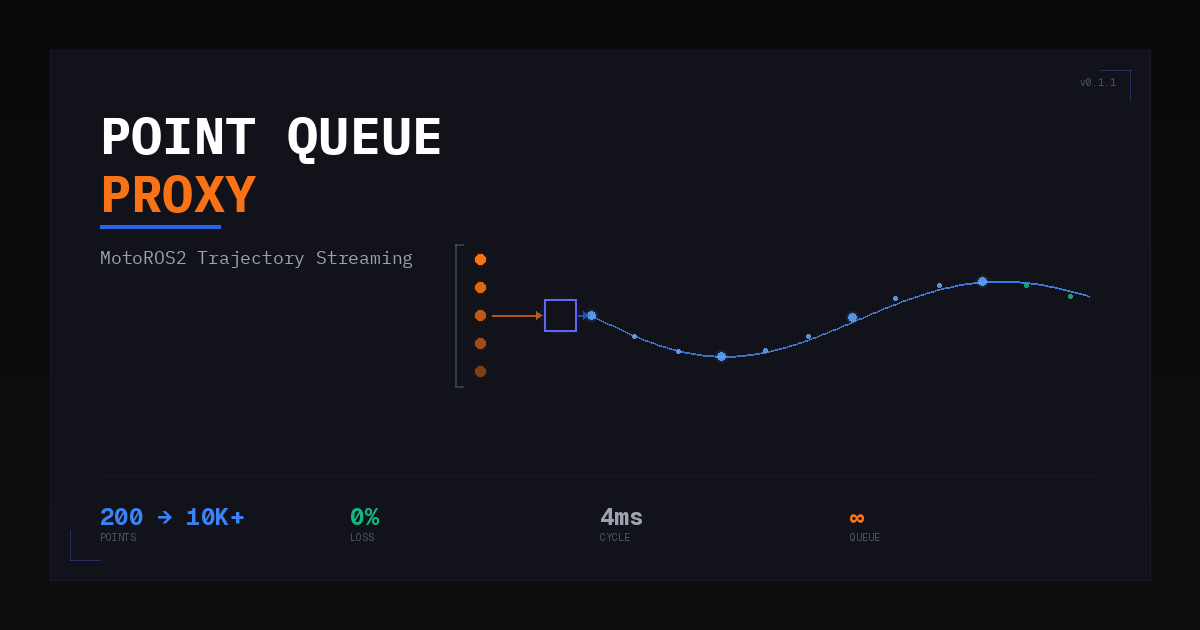
MotoROS2 Point Queue Proxy Server
Learn how to overcome MotoROS2's 200-point trajectory limit and execute precision trajectories with thousands of points seamlessly. We share our Proxy Server design that simultaneously overcomes Micro-ROS structural limitations and QueueTrajPoint service data loss issues.
The Problem: MotoROS2's Structural Limitations
Operating Yaskawa industrial robots in a ROS 2 environment requires the official driver MotoROS2. MotoROS2 provides two interfaces for robot motion control:
| Interface | Method | Purpose |
|---|---|---|
FollowJointTrajectory Action | Batch transfer | Send entire trajectory at once |
QueueTrajPoint Service | Point-by-Point | Send points one by one sequentially |
Applications requiring high-resolution trajectories with thousands of points - such as precision welding, 3D printing paths, or complex assembly processes - face serious limitations with both methods.
Understanding MotoROS2 Architecture
To identify the root cause, we need to understand MotoROS2's internal architecture.
Key Components:
- Micro-ROS Agent: Runs on PC, bridges standard ROS 2 DDS with XRCE-DDS for embedded environments
- MotoROS2: Runs inside YRC1000 controller as a MotoPlus application
- Motion API: Interpolates received points at 4ms intervals and delivers to servos
MotoROS2 uses Micro-ROS to implement ROS 2 communication in the embedded environment. This is where the first constraint arises.
Micro-ROS Memory Constraints
Micro-ROS is a ROS 2 implementation for resource-constrained microcontrollers. It uses the lightweight Micro XRCE-DDS instead of standard Fast-DDS, resulting in strict message size limitations.
| Parameter | Default | Description |
|---|---|---|
| MTU (Maximum Transmission Unit) | 512 bytes | Single transmission unit size |
RMW_UXRCE_STREAM_HISTORY | 4-8 slots | Reliable stream history |
| Maximum Message Size | ~64 KB | XRCE protocol limit |
Result: The maximum number of points that can be included in a FollowJointTrajectory message is limited to approximately 200.
JointTrajectory message size ~ N x (joints x 8 bytes x 4 + timestamp)
200 points x 6 joints x 32 bytes ~ 38.4 KB (< 64 KB limit)
Problem 1: FollowJointTrajectory's 200-Point Limit
The ROS 2 trajectory_msgs/JointTrajectory message specification itself has no point count limit. However, due to Micro-ROS buffer constraints, approximately 200 points per trajectory is the upper limit in MotoROS2.
Failure Mode Analysis
Phenomena when sending messages exceeding 200 points:
Symptoms:
- Messages "disappear into the void" (official GitHub Issue description)
- Action Server enters lock-up state
- Goal receipt cannot be confirmed
Common Workaround Attempts and Limitations
1. Trajectory Downsampling
# Reduce 2000 -> 200 points
downsampled = trajectory[::10]  # Select 1 every 10 points
- Problem: Precision degradation. Unsuitable for processes requiring high resolution
2. Trajectory Chunking
# Split and send sequentially in groups of 200
for chunk in [trajectory[i:i+200] for i in range(0, len(trajectory), 200)]:
    send_fjt_goal(chunk)
    wait_for_completion()  # Wait for completion
- Problem: Robot stutters at Action transition points. Continuity cannot be guaranteed
Problem 2: QueueTrajPoint Service BUSY Response
MotoROS2 provides the queue_traj_point service as an alternative to the 200-point limit. Despite the name, there is no actual internal queue.
BUSY Response Mechanism
Physical Consequences of Data Loss
If point is discarded with BUSY and the client doesn't retransmit:
- Robot attempts to move directly from to
- Discontinuity occurs in trajectory
- Sudden position change -> Motor torque overload
Results:
- Risk of mechanical damage from physical shock
- Controller error and emergency stop (E-Stop) activation
- Process interruption and productivity loss
Mathematical Analysis of Trajectory Discontinuity
In continuous trajectories, continuity of position , velocity , and acceleration is important:
When point is lost, the controller targets in the next time slot. Assuming equally-spaced trajectory ():
Approximately twice the distance must be traveled within the same control period , so required velocity doubles suddenly.
From a robot dynamics perspective, this leads to rapid torque changes:
When spikes, (joint torque) also spikes, activating motor protection circuits or causing mechanical shock.
Solution: Point Queue Proxy Server
To solve both problems simultaneously, we designed a Proxy Server that acts as a mediator between MoveIt2 and MotoROS2.
Design Goals
| Goal | Description |
|---|---|
| Transparent Proxy | Upper controllers (MoveIt2) use it like a standard robot controller |
| Unlimited Trajectory | Receive trajectories without point count limits |
| Lossless Streaming | All points delivered to robot in order without loss |
| Continuous Motion | Seamless operation in continuous processes |
System Architecture
Interface Design:
-
Northbound (To Planner):
FollowJointTrajectoryAction Server- Receives entire trajectories as Batch from upper planners like MoveIt2
- No point count limit
-
Southbound (To Robot):
QueueTrajPointService Client- Sends points to MotoROS2 one at a time
- Flow Control applied
-
Feedback Loop:
/joint_statesSubscriber- Real-time monitoring of robot's actual joint positions
- Convergence determination for motion completion
Core Mechanism 1: Reliable Streaming with Flow Control
A Smart Retry mechanism borrowing TCP flow control principles.
Key Parameters:
| Parameter | Recommended | Description |
|---|---|---|
busy_wait_time | 4-8 ms | Wait time between retries (based on motion period) |
max_retries | 50-100 | Maximum retry count |
service_timeout | 100 ms | Service response timeout |
Flow Control Principle:
The robot controller consumes points at a 4ms period. The Proxy Server interprets BUSY responses as "consumer still processing" signals and retransmits after appropriate delay. This is producer-consumer rate synchronization similar to TCP's sliding window.
// Backpressure-based flow control
int queue_point_with_retry(const trajectory_msgs::msg::JointTrajectoryPoint& point)
{
    int attempt = 0;
    while (rclcpp::ok() && attempt < max_retries_) {
        auto request = std::make_shared<motoros2_interfaces::srv::QueueTrajPoint::Request>();
        request->point = point;

        auto future = queue_point_client_->async_send_request(request);
        auto status = future.wait_for(service_timeout_);

        if (status == std::future_status::timeout) {
            RCLCPP_WARN(get_logger(), "Service timeout, attempt %d/%d",
                        attempt + 1, max_retries_);
            ++attempt;
            std::this_thread::sleep_for(busy_wait_time_);  // Wait after timeout too
            continue;
        }

        auto result = future.get();

        // Return result if not BUSY (SUCCESS or error)
        if (result->result_code != ResultCode::BUSY) {
            return result->result_code;
        }

        // Backpressure: Wait until consumer is ready, then retry
        ++attempt;
        std::this_thread::sleep_for(busy_wait_time_);
    }

    RCLCPP_ERROR(get_logger(), "Max retries (%d) exceeded", max_retries_);
    return ResultCode::ERROR;
}
Core Mechanism 2: Goal Queueing
Complex processes require continuous execution of multiple trajectories. The conventional approach required waiting for the current motion to finish before sending the next command.
Goal Queueing accepts new Goals even during motion execution, stores them in an internal queue, and automatically starts the next motion immediately upon current motion completion.
Advantages of Asynchronous Queueing:
- Upper controller can pre-send commands without checking robot state
- Minimized transition delays between motions -> Seamless continuous processes
- Robust architecture against network delays
Core Mechanism 3: Convergence Detection
All points sent != Physical motion complete
We must confirm the robot has actually reached the last point before safely starting the next trajectory.
Convergence Determination Algorithm:
Where:
- : Actual joint position received from
/joint_states - : Last point of trajectory
- : Convergence threshold (e.g., 0.001 rad = 0.057 deg)
bool check_convergence(const std::vector<double>& target_positions)
{
    auto current_positions = get_current_joint_positions();

    // Joint count mismatch check
    if (current_positions.size() != target_positions.size()) {
        RCLCPP_ERROR(get_logger(), "Joint count mismatch: %zu vs %zu",
                     current_positions.size(), target_positions.size());
        return false;
    }

    for (size_t i = 0; i < target_positions.size(); ++i) {
        double error = std::abs(current_positions[i] - target_positions[i]);
        if (error > convergence_threshold_) {
            return false;
        }
    }
    return true;
}

void wait_for_convergence(const std::vector<double>& target_positions,
                          std::chrono::milliseconds timeout)
{
    auto start = std::chrono::steady_clock::now();

    while (rclcpp::ok()) {
        if (check_convergence(target_positions)) {
            RCLCPP_INFO(get_logger(), "Convergence achieved");
            return;
        }

        auto elapsed = std::chrono::steady_clock::now() - start;
        if (elapsed > timeout) {
            RCLCPP_WARN(get_logger(), "Convergence timeout");
            return;
        }

        std::this_thread::sleep_for(std::chrono::milliseconds(10));
    }
}
Implementation Details
ROS 2 Action Server and Threading Model
ROS 2's Executor manages callback execution. In the default Single-Threaded Executor, long loops within handle_accepted callbacks block other callbacks.
Solution: Create a worker thread in handle_accepted for asynchronous processing
class PointQueueProxy : public rclcpp::Node
{
public:
    PointQueueProxy() : Node("point_queue_proxy")
    {
        // Create Action Server
        action_server_ = rclcpp_action::create_server<FollowJointTrajectory>(
            this,
            "follow_joint_trajectory",
            std::bind(&PointQueueProxy::handle_goal, this, _1, _2),
            std::bind(&PointQueueProxy::handle_cancel, this, _1),
            std::bind(&PointQueueProxy::handle_accepted, this, _1)
        );

        // Create Service Client
        queue_point_client_ = create_client<QueueTrajPoint>("queue_traj_point");

        // Joint States Subscriber
        joint_states_sub_ = create_subscription<JointState>(
            "joint_states", 10,
            std::bind(&PointQueueProxy::joint_states_callback, this, _1)
        );
    }

private:
    rclcpp_action::GoalResponse handle_goal(
        const rclcpp_action::GoalUUID& uuid,
        std::shared_ptr<const FollowJointTrajectory::Goal> goal)
    {
        RCLCPP_INFO(get_logger(),
            "Received goal with %zu points",
            goal->trajectory.points.size());
        return rclcpp_action::GoalResponse::ACCEPT_AND_EXECUTE;
    }

    void handle_accepted(const std::shared_ptr<GoalHandleFJT> goal_handle)
    {
        std::lock_guard<std::mutex> lock(queue_mutex_);

        if (is_executing_) {
            // If executing, store in queue
            goal_queue_.push_back(goal_handle);
            RCLCPP_INFO(get_logger(), "Goal queued. Queue size: %zu",
                        goal_queue_.size());
        } else {
            // If idle, execute immediately
            is_executing_ = true;
            std::thread(&PointQueueProxy::execute_trajectory, this, goal_handle)
                .detach();
        }
    }

    void execute_trajectory(std::shared_ptr<GoalHandleFJT> goal_handle)
    {
        auto goal = goal_handle->get_goal();
        auto result = std::make_shared<FollowJointTrajectory::Result>();

        RCLCPP_INFO(get_logger(),
            "Executing trajectory with %zu points",
            goal->trajectory.points.size());

        // Stream all points
        for (size_t i = 0; i < goal->trajectory.points.size(); ++i) {
            if (goal_handle->is_canceling()) {
                goal_handle->canceled(result);
                process_next_goal();
                return;
            }

            int ret = queue_point_with_retry(goal->trajectory.points[i]);
            if (ret != ResultCode::SUCCESS) {
                result->error_code = FollowJointTrajectory::Result::INVALID_GOAL;
                goal_handle->abort(result);
                process_next_goal();
                return;
            }

            // Publish Feedback (optional)
            if (i % 100 == 0) {
                auto feedback = std::make_shared<FollowJointTrajectory::Feedback>();
                feedback->desired = goal->trajectory.points[i];
                goal_handle->publish_feedback(feedback);
            }
        }

        // Wait for Convergence
        auto last_point = goal->trajectory.points.back();
        wait_for_convergence(last_point.positions,
                             std::chrono::seconds(30));

        result->error_code = FollowJointTrajectory::Result::SUCCESSFUL;
        goal_handle->succeed(result);

        process_next_goal();
    }

    void process_next_goal()
    {
        std::lock_guard<std::mutex> lock(queue_mutex_);

        if (!goal_queue_.empty()) {
            auto next_goal = goal_queue_.front();
            goal_queue_.pop_front();
            std::thread(&PointQueueProxy::execute_trajectory, this, next_goal)
                .detach();
        } else {
            is_executing_ = false;
        }
    }

    // Member variables
    rclcpp_action::Server<FollowJointTrajectory>::SharedPtr action_server_;
    rclcpp::Client<QueueTrajPoint>::SharedPtr queue_point_client_;
    rclcpp::Subscription<JointState>::SharedPtr joint_states_sub_;

    std::mutex queue_mutex_;
    std::deque<std::shared_ptr<GoalHandleFJT>> goal_queue_;
    std::atomic<bool> is_executing_{false};

    // Configuration
    std::chrono::milliseconds busy_wait_time_{5};
    int max_retries_{100};
    double convergence_threshold_{0.001};  // rad
};
Parameter Tuning Guide
| Parameter | Low Value | High Value | Recommended |
|---|---|---|---|
busy_wait_time | Fast send, frequent BUSY | Slow send, stable | 4-8 ms |
max_retries | Fast failure, unstable | Slow failure, stable | 50-100 |
convergence_threshold | Precise, long wait | Loose, fast transition | 0.001 rad |
Tuning Principles:
- busy_wait_time: Set based on MotoROS2's internal Motion API operating at 4ms period
- max_retries: Set generously considering network delays and complex trajectories
- convergence_threshold: Match with subsequent trajectory starting point tolerance to prevent discontinuity
Experimental Results
Test Environment
| Item | Specification |
|---|---|
| Robot | Yaskawa GP12 (6-axis) |
| Controller | YRC1000 |
| MotoROS2 Version | 0.1.1 |
| ROS 2 Distribution | Humble |
| Network | 1 Gbps Ethernet (direct) |
Quantitative Results
| Metric | Before (Default MotoROS2) | After (Proxy Server) |
|---|---|---|
| Max points/trajectory | 200 | 10,000+ |
| Trajectory continuity | Stuttering when split | Fully continuous |
| Point loss rate | Variable (when BUSY unhandled) | 0% |
| Continuous process wait time | ~500ms (Action transition) | < 10ms |
Real Application Cases
Precision Welding Pattern
- Complex seam tracking: 3,200 points
- Before: Split into 16 Actions -> Welding quality degradation
- Proxy Server: Single Action continuous execution -> Uniform weld bead
3D Printing Path
- Average 5,000+ points per layer
- Seamless extrusion improves layer quality
Limitations and Future Work
Current Limitations
-
Real-time Servoing Not Supported
- Current architecture is optimized for pre-planned trajectory execution
- Additional development needed for real-time path correction based on sensor feedback
-
Single Robot Control
- Multi-robot synchronization not supported
- Goal synchronization mechanism planned for future
-
Error Recovery
- Rollback mechanism for partially executed trajectories on mid-execution failure not implemented
Future Improvements
- MotoROS2 Point Streaming Interface (v0.0.15+) integration
- Multi-robot synchronization support
- Trajectory Blending for smoother transitions
Key Takeaways
-
MotoROS2's 200-point limit stems from Micro-ROS message size constraints (~64KB).
-
QueueTrajPointservice has no actual queue, causing data loss onBUSYresponses. -
Point Queue Proxy Server solves both problems simultaneously:
- Reliable Streaming: Flow control prevents point loss
- Goal Queueing: Seamless execution of continuous processes
- Convergence Detection: Confirms physical motion completion
-
Core Technology: Applying TCP flow control principles to robot motion control
Precise trajectory control can overcome driver limitations through appropriate middleware design.